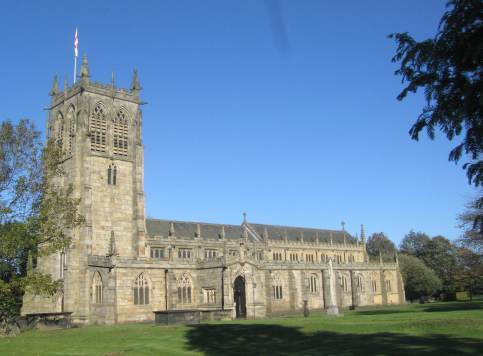
St. Chad's parish Church, Rochdale with one of the gargoyles.
There was, the site indicates, a Church on Sparrow Hill long before 1194.
A wall, reputedly of Saxon origin, still stands to the north of the present edifice. Legend insists that Rochdale was a town visited by St. Chad in 669 or 670 and to whom the Church has ever been dedicated. It is a legend unsupported by historical evidence, but it is not improbable: Rochdale was a town of some importance in the Middle Ages, as is evidenced by the establishment of a market in the year 1251. The local references to a Castle both in site, and in names like Castlemere and Castleton, indicate an importance for Rochdale that was not insignificant, and when the town expanded in the time of the Industrial Revolution, it remained one of the most important in this part of Lancashire.
The bottom of the Church tower together with the alternating round and octagonal pillars in the Nave date from the time of the first Vicar, Geoffrey of Whalley who was Vicar in the year 1194. He owed his appointment to the local de Lacy family, powerful representatives of the King.
The Church is known as a 'Double Apostle' building due to the number of arches, its size was doubled in the 1880's being completed in 1888 during Canon Maclure's incumbency. This had the effect of making the section alotted to the Choir slightly larger than that allotted to the congregation, the intention being to adopt the style of a Cathedral. The clerestory windows picture the Apostles.
The older parts of the church is built in millstone grit while the extension is of Yorkshire sandstone.
The Octingentenary (800 year anniversary) was marked on December 1st 1994 by a visit from Her Majesty, The Queen and His Royal Highness, The Duke of Edinburgh.
Bet Lynch was married here.